

In May 2024, Longview entrusted its public schools with a $456.2 million investment in the future. The first year tested how that trust would be carried from the ballot box into classrooms, campuses, and the daily work of a changing district.
A first-anniversary chronicle of the May 2024 bond election and the year that followed, through May 5, 2025.
A school bond begins with numbers, but its consequences are lived in ordinary moments: a child arriving at a secure entrance, a teacher arranging a classroom around a lesson, a teenager learning to use the tools of a future profession. The people who approved Longview ISD's 2024 bond would judge its value through those experiences long after the election totals stopped making news.
The first anniversary therefore deserves more than a list of projects. It offers a view of how a community's decision becomes a district's responsibility, and how that responsibility is carried across changes in leadership, unexpected disruption, and the less visible choices that determine what students will eventually receive.

Part I: The Passage
The results came in fast. FIVE FOR FIVE. By 8:05 p.m. on May 4, 2024, Longview was celebrating a decisive vote for its schools.
All five propositions in the Longview ISD bond election passed, authorizing $456.2 million for campus improvements, security, transportation, technology, and new facilities. Each proposition secured a clear majority. Together, the results gave the district the authority to address needs that reached across school sites and generations of students.
For many, it felt like a generational turning point.
The district's election-night report recorded 3,073 votes for Proposition A and 1,602 against; 2,845 for B and 1,813 against; 2,718 for C and 1,930 against; 2,700 for D and 1,952 against; and 2,815 for E and 1,837 against. The margins differed, but all five passed. Voters had considered distinct commitments and authorized each of them.
Those results did not erase disagreement. They established the decision under which the district would proceed. People who had supported the proposal and people who had opposed it would share the same interest in careful spending, clear explanations, and schools that served children well.
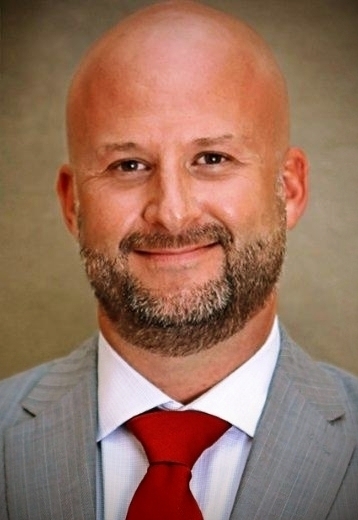 “We knew we were out of chances,” said Mr. Michael Tubb, Longview ISD Board President. “This was bigger than buildings. It was about whether this community still believed in itself—and in its kids.”
“When the vote came back yes, I felt the ground settle. Like we’d finally turned the page,” Mr. Tubb added. “Now it’s on us to make sure this story was worth saying yes to.”
That sense of relief, and responsibility, rippled across every corner of the district.
The parents and neighbors who had knocked on doors, answered difficult questions, and made the case for the proposal understood how much lay behind those numbers. Support had been earned in conversations, often one household at a time.
 “It was about excellence,” said Ms. Karen Haas, a civic-minded LISD parent with strong ties to Longview’s business and philanthropic community. “About saying that our kids—all of our kids—deserve the kinds of facilities and programs that make people want to move here. To stay here. To believe in public education again.”
Ms. Haas was one of several leaders behind the Vote Yes For Longview ISD Kids PAC, a diverse, grassroots group of parents, pastors, business owners, and alumni who organized relentlessly in the weeks and months leading up to the election.
The campaign drew strength from the fact that its advocates knew the schools in different ways. Some saw them through their children's experience. Others understood the connection between a strong district and the community's future. Their voices gave the proposal a local meaning that no set of architectural drawings could supply on its own.
The level of detail mattered to supporters like Mr. Thomas Norris, a deeply respected and conscientious voice in the Longview community.
“You could tell this wasn’t a wish list—it was a blueprint,” Mr. Norris said. “They weren’t just asking us to hope. They were showing us a plan.”
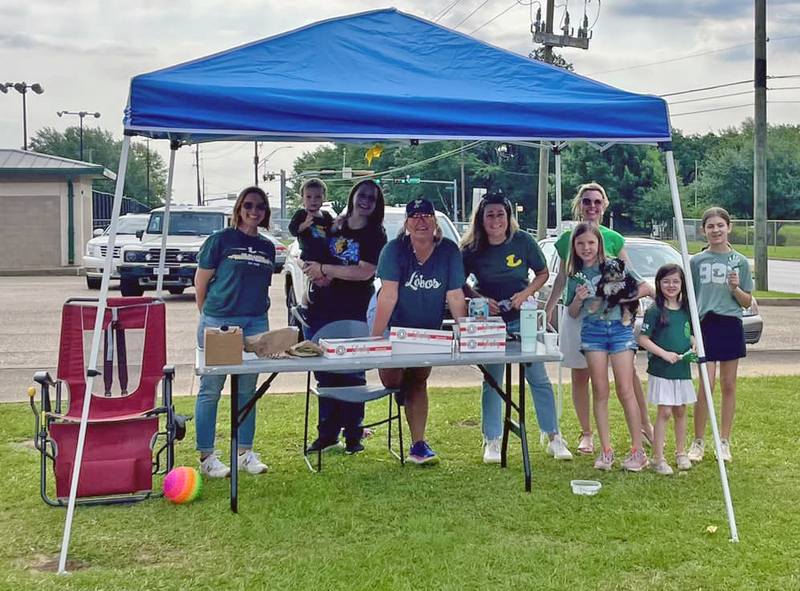 One of the most passionate voices belonged to Ms. JoCarol Cox, a longtime advocate and fierce defender of LISD students and staff.
“People tried to divide us, either politically or economically or even racially—they tried to pit districts or parts of town against each other—or say this bond was too much, too soon,” she said. “But we knew the truth: this bond was for the kids. And for once, most of Longview voters believed and understood.”
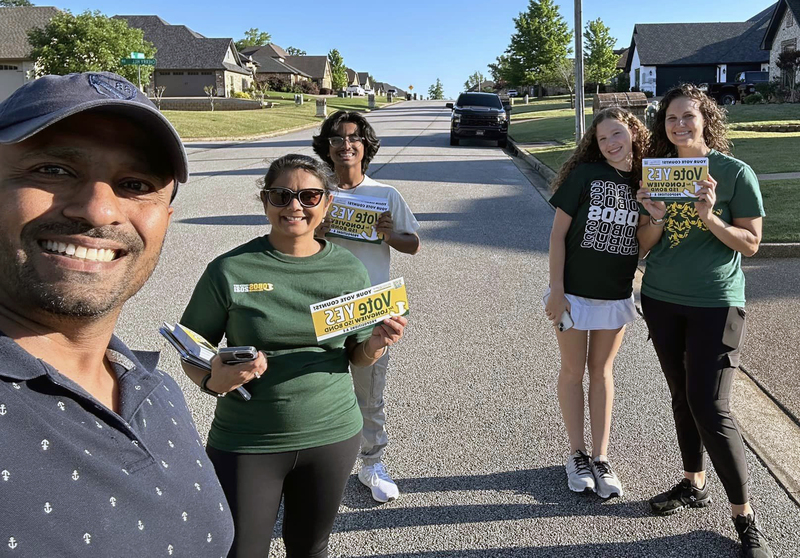 Mr. Krupal Patel, an active Longview ISD parent and local entrepreneur, knocked doors and spoke at neighborhood meetings, even among those who had questions or hesitations.
“People wanted transparency. They wanted assurance,” Mr. Patel said. “And when they saw how thorough the plan was—how thoughtful—it built a quiet confidence. Not hype. Trust.”
 But that confidence had taken time to rebuild.
The 2024 proposal was the district's third recent attempt to secure voter authorization for major facilities improvements. Two unsuccessful elections had left the needs unresolved and the task of explaining them unfinished. Trustees, district staff, and consultants revisited the scope and listened to the community before bringing the proposal back.
 At one event, Mr. Joe Weber stood at the front of the group, voice rising with conviction. A business owner and parent, Weber had become known for his boundless energy and relentless advocacy.
“We’re not trying to catch up to the big city suburban districts,” he told those in attendance. “We’re trying to compete with and even surpass them. Because we can. Because this is Longview! We're the Lobos!”
The proposals extended from modernization of existing schools to a new Early Childhood Center, expanded Career and Technical Education facilities, a multipurpose indoor facility, and a natatorium. Transportation improvements, technology, campus safety, and accessibility were also part of the larger investment. The breadth of that work helps explain why the election mattered to families whose children were at very different stages of their education.
For a young child, the promise of a new early-learning space was about the beginning of a school experience. For a high school student, expanded career education could shape what came after graduation. For staff, improvements to security, access, and building systems concerned the conditions in which they did their work every day. The bond joined those needs within one investment without making them interchangeable.
 “This bond wasn’t rushed. It was shaped,” said Mr. Jesús Mancha, treasurer of the PAC and a tireless volunteer with ties to the restaurant and business community across the city. “The district listened. The trustees listened. And we took the time to build something that reflected the real needs of our students.”
On election night, Mr. Mancha and his fellow PAC members watched the results arrive from across Longview. Their coalition included people with different backgrounds and different connections to the schools, brought together by a shared commitment to students.
“I remember feeling at peace,” he said. “We knew we had done the work. And when the people spoke, they spoke with clarity.”

For lifelong residents who had seen generations come and go, the tone was hopeful.
Ms. Marie Edwards, a proud Lobo parent and grandmother, a Longview ISD alum, and lifelong resident of the community, said it plainly.
“I’ve waited a long time for this. And I’m proud of our city for saying yes,” she said.
Only later, after the dust had settled, did Rev. LaDarian Brown reflect on the deeper meaning.
 “This bond wasn’t about buildings,” said Rev. Brown, a Longview ISD alum, pastor, father of young LISD students, and spokesperson for the Longview Police Department. “It was about affirming that our children are worth the investment. That their future matters. That we believe in them—even when the world tries to say otherwise.”
That language of worth ran through the election's meaning. Buildings alone cannot guarantee learning, belonging, or opportunity. They can, however, either support those aims or make them harder to achieve. Longview had chosen to confront the condition of its facilities as part of its responsibility to students.
As the final tallies came in, celebrations erupted at homes, churches, and watch parties across the city.
For supporters, the result marked a change in what the community believed it could accomplish together. The district had received permission to build, and with it the responsibility to keep explaining, listening, and delivering after the celebrations ended.
 For Mr. Matthew Prosser, then Director of Communications & Community Relations, the mood in the days that followed was part gratitude, part resolve.
“The triumph at the ballot box was really just the starting line,” he said. “The real work was only just beginning.”
For Prosser, the change from election to implementation brought familiar community questions into a new setting. Families who had wanted to understand the proposal would now want to understand its progress. The district's public explanation needed to keep pace with its decisions, and the people doing the technical work needed a clear view of what residents were asking.
The work required continuity. An election campaign has a natural ending; the relationship between a school district and its community does not. The first year would show how Longview intended to remain accountable to the people who had entrusted it with the next chapter.
Part II: The Alignment
After the vote, the work changed character. The public decision had been made. Now it had to become a workable program.
In the days that followed, district staff turned toward implementation. A successful election could authorize an investment, but it could not settle the design of a classroom, the sequence of a campus renovation, or the terms under which a contractor would be held accountable. Those decisions required their own care.
 “This part of the process isn’t loud,” said Dr. Wayne Guidry, Chief Financial Officer. “It’s legal reviews, compliance audits, bond draw-down schedules. It’s a lot of front-loaded rigor so you don’t make expensive mistakes down the line.”
Through the summer of 2024, the district assembled the legal, financial, and professional framework for a multiyear effort. Architects had to understand educational needs. Construction partners had to understand the district's expectations. The schedule had to account for schools that would remain in use, with students arriving each morning regardless of what appeared on a project calendar.
On July 15, trustees approved DLR Group's architectural services contract for the CTE and multipurpose facilities. Further selections followed in August: DLR for the natatorium and GFF Design Group for the Early Childhood Center and Transportation Center. By October 21, trustees had approved construction and renovation timelines, giving the program a more visible structure while design work continued.
“There’s no marching band for procurement schedules,” said Mr. Prosser, who now serves as the district's Chief of Strategic Initiatives. “No one cheers for bid tabulations or contract language. But if you don’t do those things right, nothing else works.”
For taxpayers, these early decisions established who would carry out the work and how the district would organize it. For school staff, they opened the opportunity to translate everyday experience into requirements that designers could use. A campus is a workplace and a learning environment before it is a construction site.
The district was also navigating a change in leadership during these formative months.
 On June 25, 2024, trustees hired Dr. Marla Sheppard as Superintendent of Schools. She inherited a voter-approved program with substantial work still ahead and the responsibility to connect its facilities investments to the district's instructional mission.
“Dr. Sheppard didn’t ask us to slow down,” said Dr. Guidry. “She asked us to show her the systems. The playbook. Dr. Sheppard wanted to know where we were, what was vulnerable, and how to accelerate where possible.”
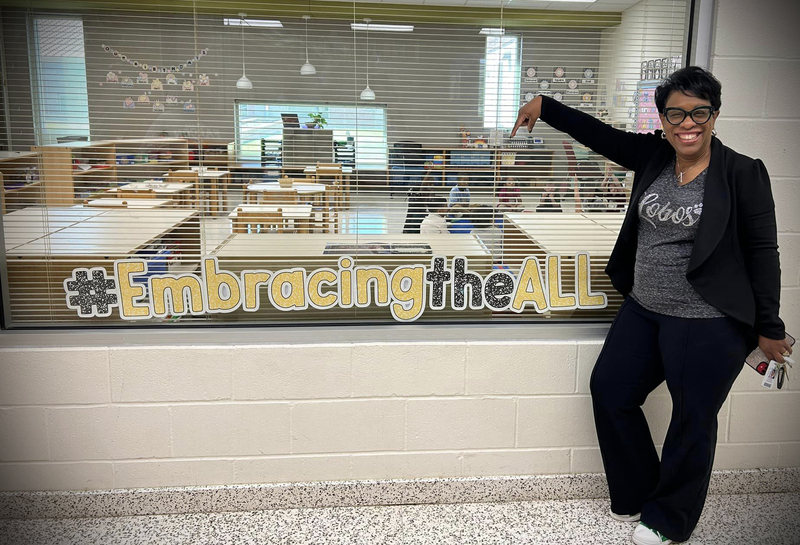 Her 100-Day Plan included campus visits and public Listening & Learning meetings. As she built her leadership team and reviewed district systems, the bond program became one of the places where educational priorities, operational responsibilities, and community expectations had to be considered together.
A public-facing bond portal gave families, staff, and taxpayers a place to follow project documents, board updates, design previews, and timelines. Keeping those materials available mattered throughout the planning period, when a passing view of a campus could reveal little about the decisions being made for it.
 “It isn't a marketing page,” said Ms. Elizabeth Ross, then Multimedia Coordinator. “It was a live filing cabinet—timelines, floorplans, vendor approvals. Everything people need to track progress themselves.”
In July 2024, Prosser was already emphasizing the questions residents would ask while the largest projects remained on paper: what had happened since the election, what would happen next, how the community could contribute, and how spending would be explained. Those questions reached across departments. Answering them meant keeping the public's experience connected to the work of the people planning, financing, and designing the facilities.
A useful public record also needed to preserve context. A floor plan without an explanation could leave a parent wondering which students it would serve. A schedule without its dependencies could make a reasonable target look like an unconditional promise. The district's responsibility was to provide enough information for people to understand progress without requiring them to become construction specialists.
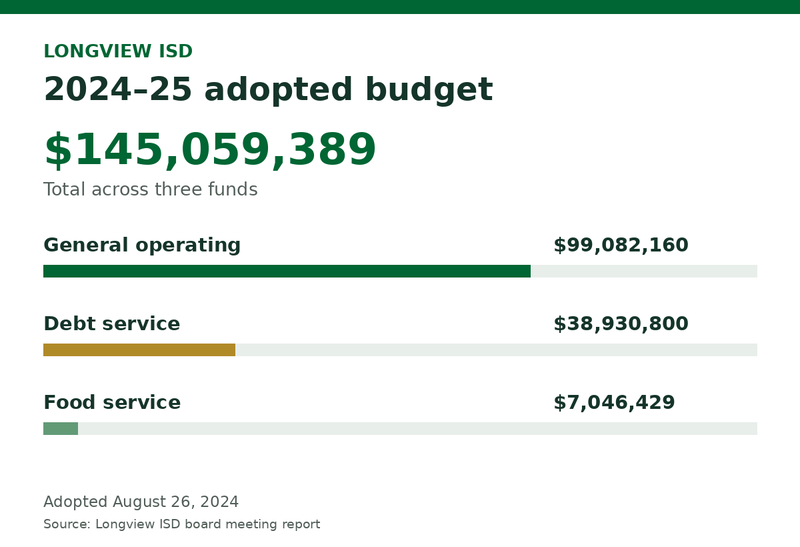
The August 26 budget and tax-rate adoption supplied an early financial benchmark. Trustees adopted a total rate of $1.1399 per $100 of taxable valuation, down from $1.1422 in 2023–24. The total combined a maintenance-and-operations rate of $0.6569 and a debt-service rate of $0.4830. The debt-service portion rose by one cent from the prior year, while a larger reduction in the operating rate lowered the combined total. The budget included payments on the new bonds as well as existing debt.
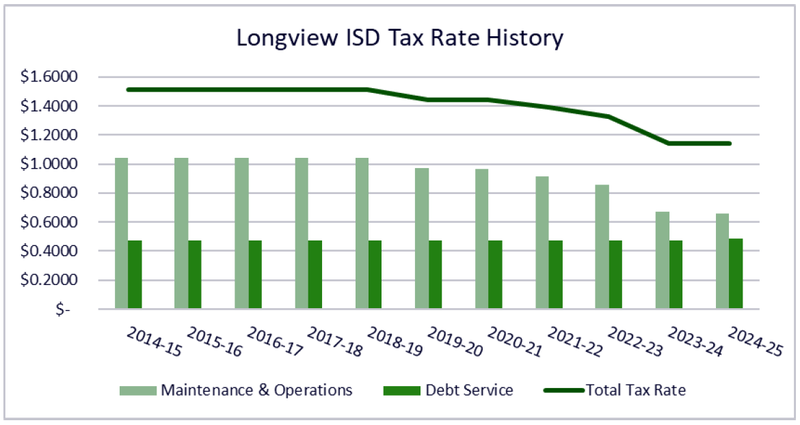 “It's my understanding that there were concerns that the May 2024 bond would automatically raise taxes,” said Dr. Sheppard. “But we’ve proven that smart management and honest planning can expand opportunity and protect taxpayers. The numbers speak for themselves.”
The distinction between a tax rate and a tax bill was essential to that explanation. Appraised values and exemptions also affect what a property owner pays. At the August meeting, Guidry explicitly noted that rising taxable values could increase collections even as the district lowered its rate. The financial story was stronger when those facts were considered together.
 In October, trustees approved leadership changes to support the district's expanding responsibilities. Mr. Samuel Kington, an experienced facilities leader, was hired as Chief of Facilities & Operations, with his arrival announced for December. Mr. Prosser was promoted to Chief of Strategic Initiatives, effective immediately. Dr. Kettisha Jones was named Deputy Superintendent of School Innovation & Student Performance, with a January 2025 start.
As those responsibilities took shape, Kington's facilities leadership complemented Guidry's work in financial planning and oversight. Construction sequencing, site logistics, and readiness required sustained operational attention, while the Business Office continued managing the financial commitments behind them.
Prosser's promotion to Chief of Strategic Initiatives carried his community-relations experience into a broader assignment. He had joined LISD in 2016 after a career in journalism. By the bond's first anniversary, his work included bringing project information together for public updates and helping prepare the questions that district leaders and construction partners would need to address with the community.
The different responsibilities were complementary. Trustees governed the investment. The superintendent set district direction. Finance and facilities leaders managed distinct obligations. Teachers, staff, and project specialists supplied knowledge that the plans needed. Keeping those contributions connected to the public purpose was part of making the whole effort understandable.
Before the new team was fully in place, an unexpected emergency tested the district's ability to keep serving its campuses.
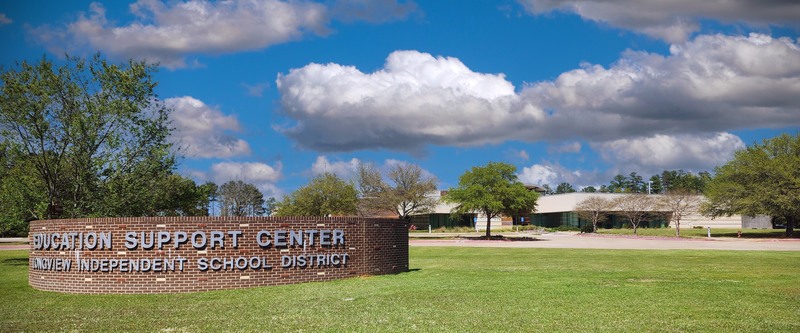
The Education Support Center before the November 2024 fire. File photo.
On November 22, 2024, a fire at the Longview ISD Education Support Center forced the closure of the administrative headquarters. Significant smoke damage displaced central-office staff, requiring the district to relocate people and essential functions while maintaining support for schools.
“There wasn’t time to process it emotionally,” said Dr. Guidry. “Everyone just adapted. Found a new chair or desk. Opened their laptops. Kept moving.”
The immediate challenge was shared across the district: preserve campus support, human resources, finance, transportation, and bond planning while normal working arrangements were disrupted. As Kington began his role, recovery and facilities needs joined the construction responsibilities already awaiting him.
The objective was continuity. New workspaces and revised arrangements had to support the same daily obligations. By February, trustees were approving ESC repair contracts that addressed HVAC replacement, fire mitigation, and roof repairs, while the bond program continued moving through its own decisions.
The fire also raised a reasonable question for taxpayers: would rebuilding the administrative headquarters draw money away from the projects they had approved? By the first-anniversary review, the district's financial leadership had clarified that insurance was covering fire-recovery costs, with fund balance supporting roof and HVAC improvements. Bond funds were not being spent on the ESC recovery.
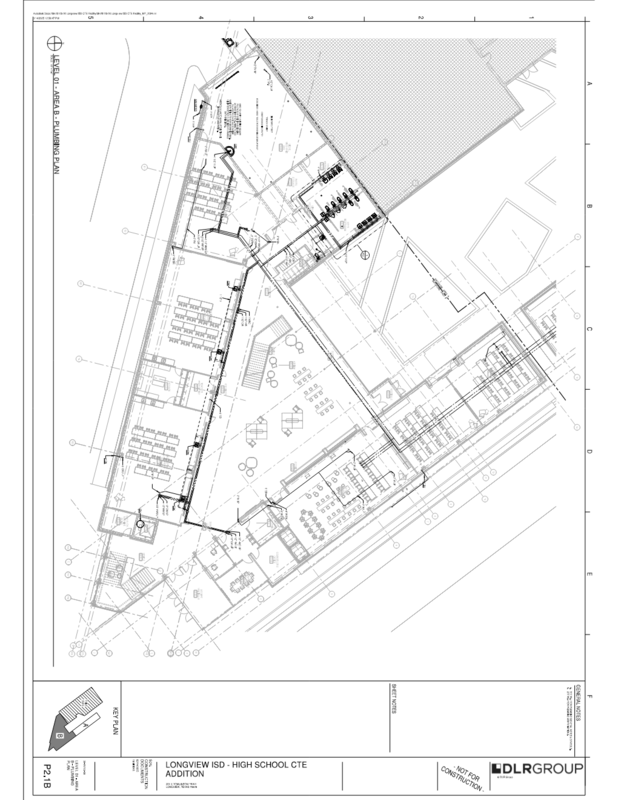 Despite the disruption, design and planning continued. Safety and renovation work moved forward alongside the longer development of new buildings. The district had to manage an urgent repair effort without losing sight of the separate commitments made to voters.
The ESC emergency made the importance of institutional continuity unusually plain. Schools depended on services that could not simply pause because the offices supporting them had become unavailable. The district's response was measured in the work that continued: support for campuses, decisions that still needed to be made, and responsibilities that remained in force despite the disruption.
Throughout this period, Guidry and the Business Office remained focused on borrowing costs, available cash, and the timing of expenditures. Their task was to make the financing serve the work over several years, rather than treating the election total as money to be spent all at once.
 The financing plan adopted in July called for the $456.2 million authorization to be issued in three installments, beginning with $200 million in 2024. That phased approach connected the borrowing program to the expected course of construction. The distinction matters: voter authorization, debt issued, contracts awarded, and money spent are related measures, but they describe different stages of the same public investment.
Construction-management decisions also developed in stages. In February 2025, trustees selected CDI Contractors as construction manager at risk for the natatorium and SCI Construction for the CTE and multipurpose facilities. The natatorium and multipurpose contracts followed in April. These steps established responsibilities for major new facilities while design and cost review continued.
“We don’t move with noise,” said Dr. Sheppard. “We move with precision. These contracts are the quiet proof that the work is real.”
Communicating those milestones required care. A contract was evidence of progress, but it was not a finished building. A rendering could show an intention, but it could not establish that every design or price was final.
“There was real progress happening,” said Mr. Prosser. “But we didn’t want to shout before we had something to show. We wanted our first public-facing moves to be meaningful, not performative.”
The framework assembled during the first months gave the program a leadership structure and a public record for the more demanding phases ahead. The next test would be how well those arrangements held as designs became more specific, costs were examined more closely, and construction began to touch the daily life of campuses.
Part III: The Planning Year
By early 2025, Longview ISD was working on two fronts: bringing major new facilities through design and cost review, while carrying out improvements that could proceed on existing campuses.
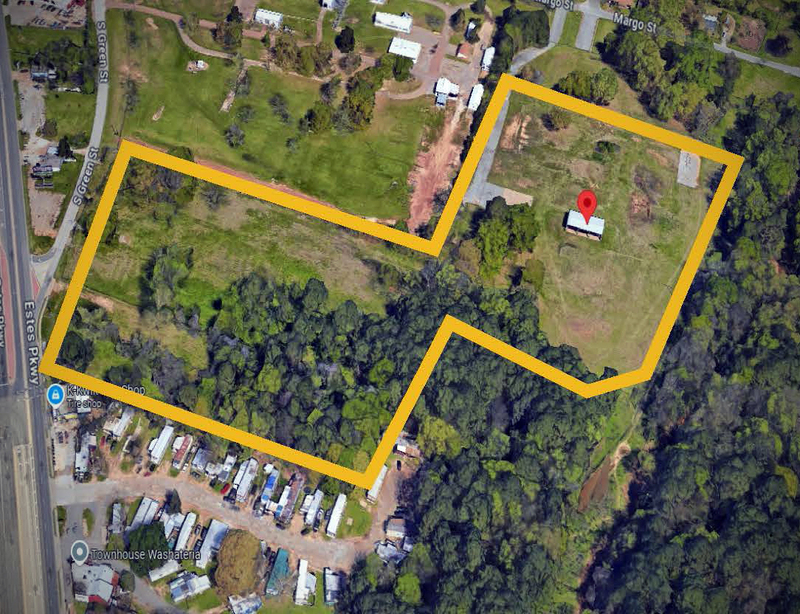 The large new buildings still demanded considerable preparation. Architects, instructional leaders, and facilities staff were working through layouts, equipment requirements, and the practical relationship between a proposed room and the students who would use it. The progress was real, even where it was not yet visible from the street.
“We weren’t looking for headlines,” said Superintendent Dr. Marla Sheppard. “We were looking for stability. Because once construction begins, you want the messiness of building, not the messiness of disorganization.”
Throughout the spring, designs for the natatorium, CTE Center, and multipurpose indoor facility continued to develop. The Early Childhood Center and Transportation Center also moved through review. The projects had different demands and different schedules, but each required a clear understanding of how it would support the district's educational work.
“This is where bond work becomes educational work,” added Dr. Sheppard. “We’re not just putting up buildings—we’re setting the conditions for stronger instruction, deeper engagement, and better outcomes.”
The educational questions were concrete. What should a career laboratory allow students to do? How would a teacher supervise a room? Could a space accommodate the equipment required by the program it was meant to support? How would students move safely between activities? A good design had to answer those questions before its appearance could become the principal measure of success.
That is why the first year mattered to students who might never attend a planning meeting. Choices made early could influence years of teaching, maintenance, and use. The consequences would remain after the original project teams had moved on to other work.
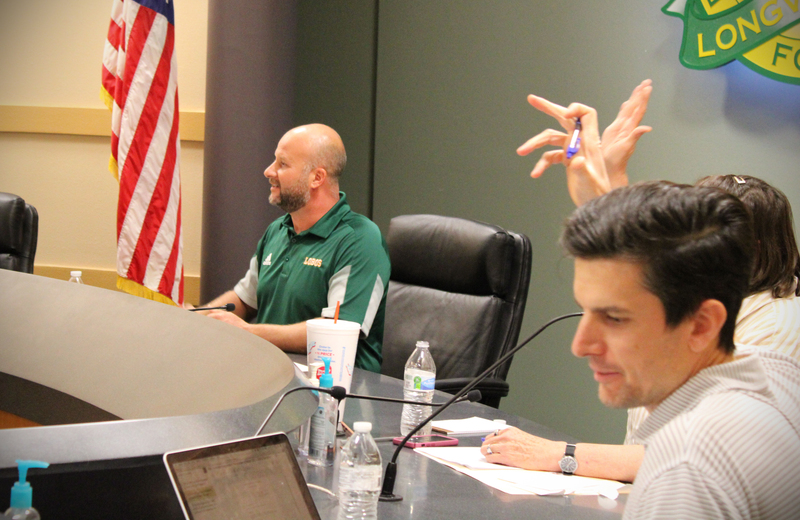 By the February 10 board update, the district was reporting approximately $4.8 million in savings associated with procurement and project management. It was a meaningful early result within a program whose largest construction obligations still lay ahead.
The financial picture required more than one number. Phased bond sales, assumptions about property-value growth, construction estimates, and the adopted tax rate all affected how the program would be carried out. District leaders sought to address urgent facilities needs while managing the burden on taxpayers over time.
“We didn’t just pass a bond,” said Dr. Guidry. “We passed it responsibly. Every phase was designed to avoid overburdening homeowners while still addressing urgent needs.”
Dr. Sheppard emphasized the relationship between cost control and the work students would ultimately receive.
“Every dollar we save without sacrificing quality is a win for the taxpayer,” said Dr. Sheppard. “And we’re doing it without compromising scope or delaying timelines.”
Early savings and favorable estimates gave the district room to respond to pressures elsewhere. They did not establish a final cost for the entire bond program. That judgment would depend on later bids, contracts, construction conditions, and the completed work. The value of the early results lay in the discipline they demonstrated and the margin they could preserve.
The April 28 project update illustrated the balance. Preliminary estimates for the multipurpose facility were $1.3 million below its construction cost limit, while the CTE addition was trending nearly $2.3 million under budget. The natatorium faced higher-than-anticipated estimates and continued value engineering. These were design-stage measures, useful for guiding decisions but distinct from final savings after construction.
Recognizing a cost pressure during design creates an opportunity to respond before it becomes a much harder problem. The purpose of review was to protect the programs the facilities would serve while keeping the community's investment in view.
The operational work grew more demanding as the plans became more detailed.
Kington coordinated architects, consultants, vendors, and district teams through design reviews and preparation for construction. The objective was to identify conflicts while they could still be resolved on paper, before they became interruptions to instruction or expensive changes on a job site.
“This is the part the public never sees,” said Mr. Kington. “But it’s where everything either succeeds or stumbles. It’s all planning, prep, and sequencing—so that when we go to build, we can just build.”
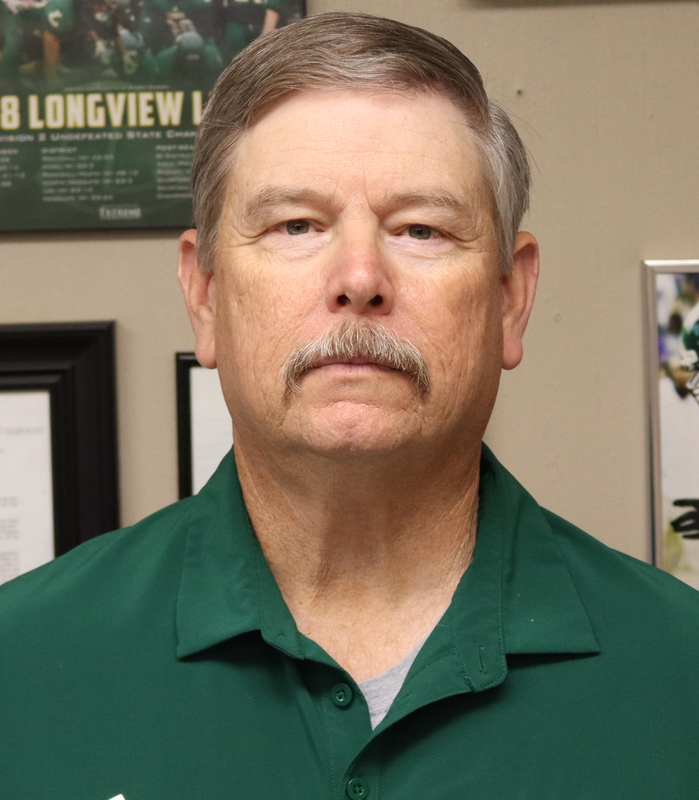 By January, longtime Maintenance Supervisor Mr. Mike Gipson was serving as the district’s Bond Construction Manager. With more than two decades of experience on the ground, Gipson brought practical familiarity with campus layouts, legacy infrastructure, and district-level project coordination.
“We’ve been working with architects to make sure they understand how these buildings actually run,” Mr. Gipson said. “It’s not just what looks good on paper. It’s what lasts.”
Gipson's practical knowledge helped connect new plans to the history of the district's buildings. A drawing can describe a future space precisely while still leaving questions about how an existing campus functions. The experience of the people who had maintained those buildings helped bring those questions into the design conversation.
Bid packages, permitting discussions, site-access planning, and equipment needs continued to develop. At the same time, work on existing facilities was already visible. The February board report recorded the start of the Longview High School baseball-field installation on January 20 and work underway at Judson's field. Lighting, electrical improvements, and security fencing were also advancing.
Campus safety was a prominent part of that early work. The February meeting included approval of a $2.77 million surveillance-system contract to replace aging cameras and servers. Together with perimeter fencing and access-control improvements, these investments addressed the everyday conditions under which students and staff used district campuses.
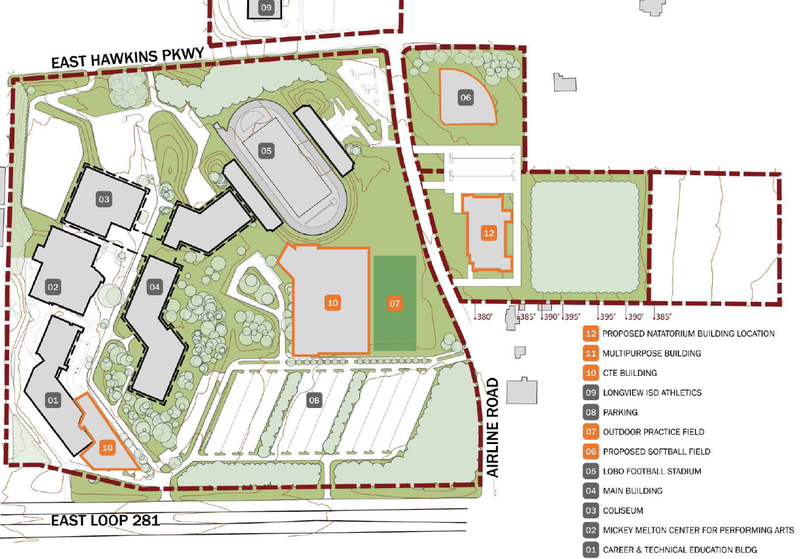 The Communications and Community Relations teams continued explaining developments while the more complex projects remained in design and review. The challenge was to help the public understand progress at different stages without suggesting that every project had reached the same point.
“We didn’t want to send out a bunch of premature updates,” said Mr. Prosser. “We wanted the story to follow the work, not the other way around.”
Within the district, that meant keeping curriculum and facilities planning connected, clarifying the work each project required, and aligning equipment and staging needs with realistic schedules. Outside it, the same work had to be explained in terms that families could use.
As spring progressed, planning calendars described construction activity during 2025, with timing varying by project. Design completion, procurement, site conditions, and campus schedules would determine when each phase could begin. The published October 2024 and February 2025 updates had already discussed midyear and third-quarter targets for major projects.
The coming construction season was becoming more tangible. It also made careful distinctions between a target, a commitment, and a completed milestone increasingly important.
“This is the quietest part of the bond,” said Mr. Kington. “But it might be the most important. Because once we’re vertical, there’s no room to hesitate. And we’re making sure we won’t have to.”
At the first-anniversary oversight review, Prosser's preparation returned to the concerns residents had raised earlier. He sought clarity on project order, the Early Childhood Center, CTE design input, natatorium operations, and the treatment of contingency funds. He also asked how teachers, students, and families were being heard. The concern was practical: an unanswered question did not disappear simply because the next project milestone had arrived.
That attention extended to the less prominent parts of the program. A question about a cross-country course, a cafeteria, or a softball field could matter deeply to the people who used it. The scale of a line in the budget did not determine the importance of the experience behind it.
Part IV: Laying Foundations
By the first anniversary, Longview's bond program had begun changing existing campuses while the district prepared its largest new facilities for construction. The visible work and the less visible preparation belonged to the same story.
“A lot of this first-year work is backend infrastructure,” said Mr. Gipson. “Things like utility easements, fire lanes, stormwater drainage—stuff that has to be right before the first slab ever gets poured.”
Early improvements to fencing, fields, and other campus systems offered one kind of evidence. The new facilities required another: coordinated designs, cost reviews, site planning, and agreements that could support construction. Neither could replace the other. Students needed improvements to the schools they used now, as well as thoughtful preparation for the spaces they would use next.
“This year has been about setting the table for everything that comes next,” said Mr. Kington. “Because when you’re managing dozens of projects with this much scope and this many moving parts, the worst thing you can do is rush out of the gate without alignment. We’ve been building the bones of this thing, so when it’s time to launch, we’re not figuring it out. We’re executing.”
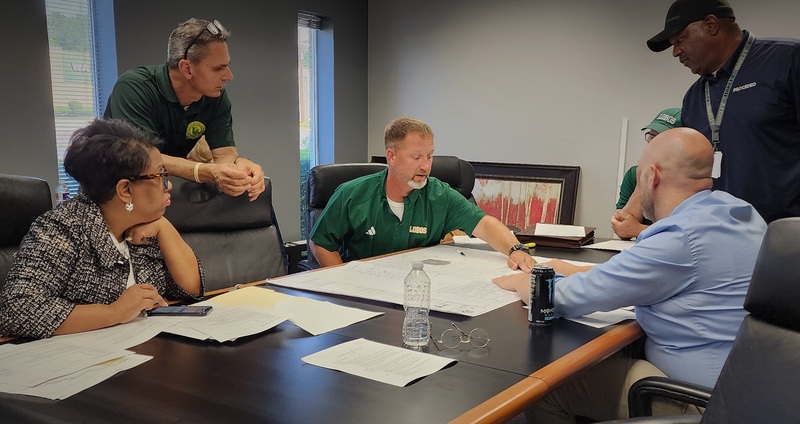 Kington and his team spent the spring reviewing construction documents, room schedules, building systems, and the relationship between available space and instructional needs. They also considered where vendors and construction crews would operate, so the practical demands of a job site would not be left for campuses to solve after work began.
“For projects of this scale, you can't just jump in and hope for the best,” he said. “It takes painstaking preparation. You've got to assemble the scaffolding before you build the cathedral.”
Complex facilities such as a natatorium or CTE Center require drawings and specifications that connect many disciplines. Structural decisions affect equipment and circulation. Equipment affects utilities. Safety requirements affect how students enter, move through, and leave a space. Reviewing those relationships is part of making the finished building usable.
“There are decisions baked into these drawings that will shape the next 40 years of instruction,” said Dr. Sheppard. “Where the lights are placed. How students enter and exit a space. Where career prep labs plug in their equipment. This is where mission meets masonry.”
The same principle applied to the district's youngest learners and to the people who kept its buses moving. An early-childhood building had to make sense at a child's scale. A transportation facility had to support the movement, upkeep, and daily readiness of a fleet. Their value would emerge through repeated use, not simply through the fact that they were new.
Dr. Guidry, who continues to oversee fiscal governance with his team in the Business Office, has remained focused on protecting the district’s long-range financial posture.
“This isn’t just about buildings,” he said. “It’s about liquidity, cash flow timing, cost escalators, bid sequencing. Our job is to make sure every dollar is working efficiently and transparently.”
The Business Office considered phased construction, changing material costs, and the timing of payments as the program developed. Those judgments mattered to every project. Money had to be available when work required it, and estimates had to leave the district prepared for costs that could change before construction was complete.
“This bond is a living portfolio,” he said. “And our responsibility is to manage it like one.”
Time was part of the financial equation. Work planned for an occupied campus had to account for the school calendar. Materials and equipment had their own lead times. A decision that appeared inexpensive in isolation could become costly if it disrupted another phase or had to be repeated. Careful sequencing was therefore part of both stewardship and service to students.
One quiet but significant development was the introduction of the district’s new IonWave digital procurement system in fall 2024. Designed to bring greater transparency and efficiency to vendor bidding, the platform became central to how LISD tracked, evaluated, and awarded bond-related contracts.
“IonWave stands to be a game changer for procurement in Longview ISD,” said Dr. Guidry. “Not only for all these bond-related projects, but for the foreseeable future in how the District awards bids with full transparency and stakeholder accountability.”
Meanwhile, Mr. Kington has led coordination meetings between architects, contractors, and site-based staff to identify campus-specific challenges, such as bus loops, staging zones, parking access, and demolition sequencing. Every campus has different constraints, and the timeline must reflect that.
“We’re not going to bulldoze our way in,” Kington said. “We’re going to sequence this work so that learning can continue with minimal disruption. That means moving in waves, with precision.”
A school construction program must coexist with the institution it is changing. Families still need to know where to drop off a child. Buses still need a safe route. Staff still need access to classrooms and equipment. Planning for those ordinary requirements helps keep the educational purpose of the work from being lost amid the construction itself.
The objective was to bring each project to construction with the necessary documents, utilities coordination, permits, and procurement in place. For occupied campuses, readiness also included making sure staff understood how access, schedules, and daily routines could be affected.
Longview ISD's program-management partners brought additional experience and capacity. Procedeo coordinated the major new structures, connecting architectural milestones, schedules, and district expectations.
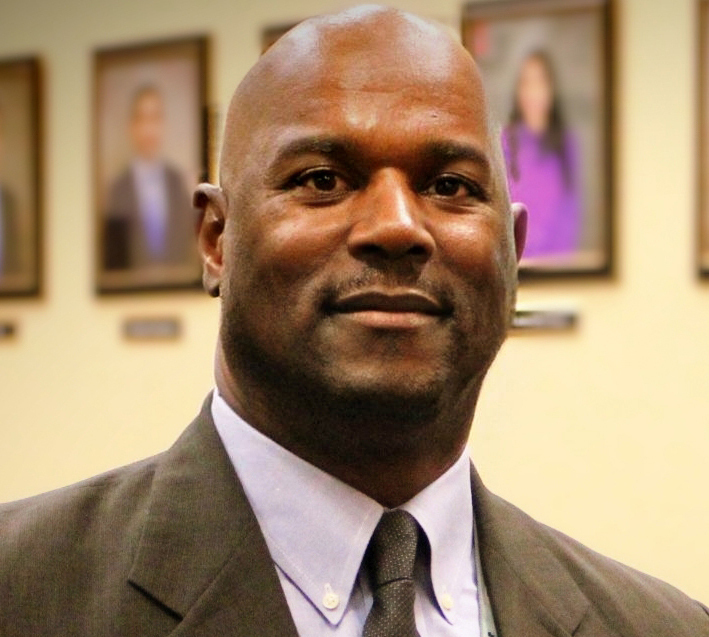 Mr. Paul Miller, who serves as Procedeo’s liaison to Longview ISD, has worked closely with both central administration and third-party contractors to ensure that projects remain on pace and aligned to spec.
Its work included design reviews, schedule development, and preparation for permitting and procurement. Those responsibilities helped the district manage projects whose size and technical requirements extended well beyond routine campus maintenance.
E4 Contracting, led by Mr. John Erickson, took responsibility for renovation work, including Longview High School and athletic facilities. That work required close attention to buildings and grounds already in daily use.
 Erickson's team focused on immediate needs as well as the larger renovations ahead. The practical question was what could be improved now and how that work could proceed while schools continued serving students.
E4's priority list wasn’t glamorous, but it was urgent: perimeter fencing at Longview High School, safety upgrades at front entry points, and functionality fixes that most stakeholders would never see but every campus would feel. These early wins offered a quiet but visible reminder that the bond was already at work.
“The first thing we did was look at what we could fix right now,” said Mr. Erickson. “Not what looked nice in a rendering. What actually mattered. Security. Functionality. Frontline issues. And that’s what we handled. Next comes the bigger lift—tying the old bones to the new build so it all works together.”
Existing schools also carry the accumulated identity of a community. Renovation asks a district to improve the conditions inside them while respecting the work and memories already associated with the place. The new buildings drew attention toward the future; the improvements to established campuses made clear that current students belonged in that future, too.
The district's public updates documented both kinds of progress: early work on existing campuses and the evolving designs of the new facilities. The growing record gave residents more to examine than an election promise or an architectural image alone.
“There hasn’t been as much external messaging as one might think—and that’s okay,” said Mr. Prosser. “This was always the quiet phase. We’ll speak louder when there’s something tangible to show. Right now, we’re speaking through systems, planning, and design.”
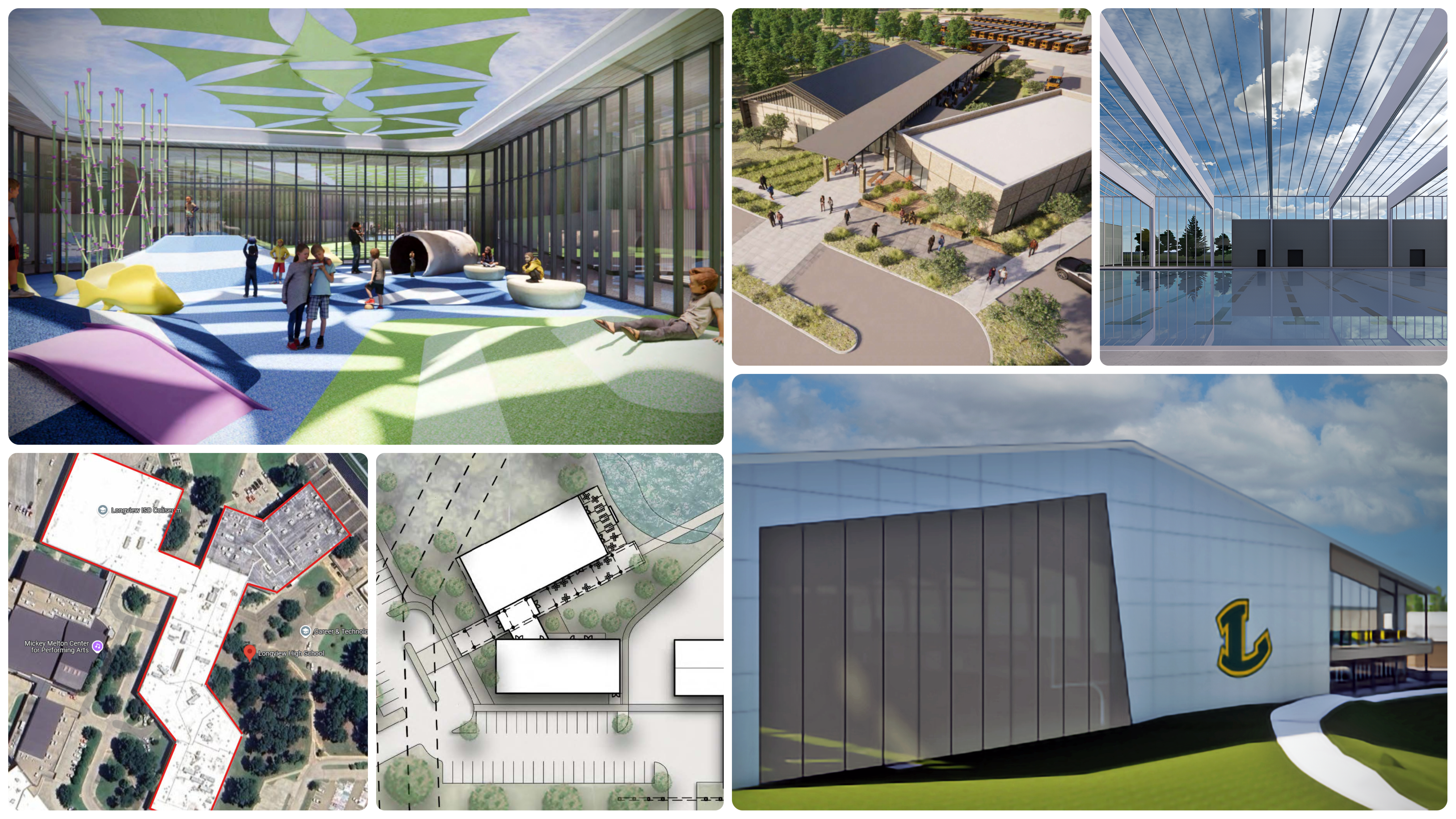
As the first anniversary approached, Prosser and the communications team were bringing updated project information and visual materials into the public conversation. Renderings and planned fly-throughs could help families understand what was taking shape. Photographs of actual work showed a different stage of progress. Presenting each for what it was kept the story useful to the people following it.
The focus remained on what the facilities would make possible for students and staff. The people with the technical knowledge could explain the designs and constraints; the district's communications work could connect those explanations to the questions families brought with them. Done well, that relationship allowed more people to follow the investment without reducing it to slogans.
The work also reached well beyond facilities and finance. Technology, child nutrition, security, curriculum, and instructional teams had a stake in the spaces taking shape. Furniture, communications systems, equipment, and student movement would all affect whether a completed facility was ready to serve its purpose.
“This isn’t just a facilities project,” said Mr. Kington. “It’s a districtwide transformation effort. And every department is on the runway.”
As those requirements came together, the bond began to look less like a collection of independent building projects and more like a long-term change in how the district's spaces could support its students. That perspective made coordination essential, because no single department would experience a new facility in isolation.
“We’re not waiting,” said Dr. Guidry. “We’re preparing. And when construction begins, it’s not going to feel like the beginning—it’s going to feel like a continuation of everything we’ve already built.”
The deeper achievement of the planning year was the opportunity to make those connections before the most expensive decisions became difficult to change. New facilities would have to work as part of a district, and the district would have to explain them as part of a shared educational future.
Part V: A Year Later...
One year after the vote, Longview had a clearer picture of both what it had accomplished and what remained to be done.
The district had moved through a leadership transition, an emergency at its administrative headquarters, major professional selections, and a year of design and financial decisions. Early campus improvements were underway. Larger facilities were moving toward construction. The work had required adaptation as well as preparation.
The $456.2 million authorization remained a long-term commitment, with its full results still ahead. The first anniversary offered a chance to assess how that commitment was being carried, rather than to claim that its outcome had already been secured.
“It’s not flashy work, but it’s what keeps a job from stalling out once construction starts,” said Mr. Gipson. “We’re lining up subs, coordinating staging areas, and making sure nobody’s stepping on each other when it’s time to move.”
Major facilities and safety projects had progressed through design, procurement, and implementation at different speeds. Some work could already be seen on campuses. Other work remained in drawings and estimates, where careful decisions could still protect its quality and cost.
“This has been the planning year,” said Mr. Kington. “And not just planning on paper—planning through action. Through meetings, modeling, reviewing, refining. We’ve been setting this up so that when we start, we start clean.”
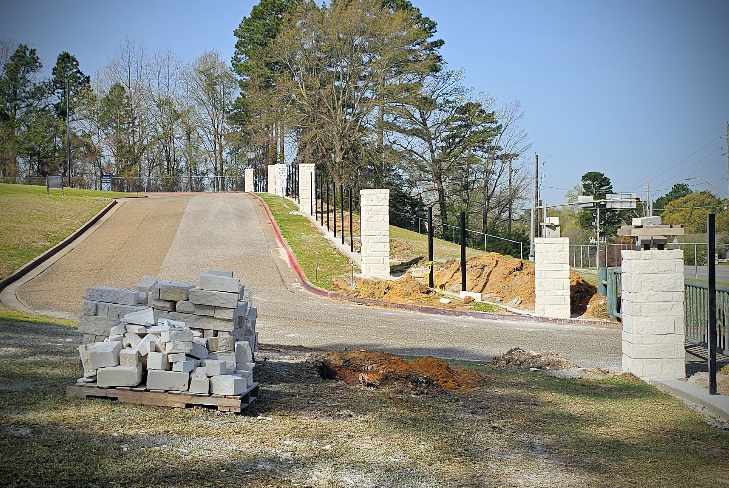 The next year would bring more visible construction and continued changes to active campuses. Preparing for that phase meant completing documents, securing permits, coordinating contractors, and giving school communities useful notice as individual projects approached work on the ground. Schedules would remain project-specific.
At the one-year mark, the record included:
Design and construction-document development for the major new facilities, with reviews continuing at different stages.
Approximately $4.8 million in reported early savings, alongside continuing cost review and favorable preliminary estimates on some projects.
Visible field, fencing, lighting, and other campus improvements, with additional security investments approved.
Clearer operational responsibilities across facilities, finance, instructional leadership, and strategic initiatives.
Public board reports, bond information online, and a community oversight structure through which questions could continue to be raised.
A lower adopted total tax rate for 2024–25, with continued attention to debt management and the cost of the work ahead.
That record supports confidence without requiring a premature declaration of completion. It contains accomplished work, work in progress, and decisions still ahead. A useful anniversary account should preserve all three, because the community's ability to judge the program depends on knowing the difference.
“There’s a maturity to how we’ve handled this year,” said Mr. Prosser. “We didn’t chase headlines. We didn’t overpromise. We did the work—quietly, thoroughly, and with an eye on the long game.”
Dr. Guidry echoed that perspective.
“Anyone can rush into construction and figure it out as they go,” he said. “That’s not who we are. We’ve set this up so that when we do go vertical, we’re not reacting—we’re delivering.”
 The first year's financial record was encouraging, but its meaning rested on precision. The adopted total tax rate had declined. Early savings had been reported. Individual project estimates showed different pressures and opportunities. None of those measures removed the obligation to manage costs through completion, and a lower rate did not necessarily mean a lower bill for every property owner.
Mr. Prosser described the community's support for the five propositions as a bet on responsible project management, fiscal stewardship, and good governance.
“And so far, that bet is paying off,” he said.
Dr. Guidry agreed.
“We never said just ‘trust us,’ we said ‘watch us,’” he said. “And now the public can see: their dollars are being managed with care, integrity, and long-term vision.”
The October 2024 approval of the Bond Oversight Committee's bylaws and guiding principles gave the public a continuing place in the effort. Community review could bring questions that a design team or district department might not encounter on its own. The value of that participation depended on treating the questions as part of the work rather than as an interruption to it.
In preparing those conversations, Prosser returned to the concern he had raised near the beginning: people needed to understand what was being done, what came next, and how their investment was being protected. Carrying questions from one discussion into the next helped keep that obligation present as the program grew more complex.
Weekly coordination continued among district staff and project partners. Scope, schedule, and readiness required repeated review. A building's opening would depend on more than completing construction: the technology, safety arrangements, staffing, and routines inside it would also have to be ready.
“We’re not just preparing for construction,” said Mr. Kington. “We’re preparing for implementation—technology, safety, staffing, student flow. Everything that has to be ready the day a building opens.”
Longview's first year drew on the community's civic life as well as its professional expertise. Voters and volunteers had created an opportunity that trustees, district leaders, educators, and builders were now carrying forward. The connection between their contributions mattered. A concern raised by a family could become a question for a designer; a teacher's experience could help determine how a room would work; a financial decision could protect what a future student would receive.
What gave the year its continuity was the obligation to carry the community's intent forward. The students who would learn in the new spaces were the reason for the technical decisions. The staff who would use and maintain them were essential to getting those decisions right. The taxpayers who would support them deserved an account they could follow and question.
Long after a ribbon was cut, the measure of the bond would be found in those relationships: whether a classroom supported teaching, whether a facility broadened opportunity, whether a campus became safer and more usable, and whether the community could see its trust reflected in the result. The first year laid the groundwork for that judgment.
The work ahead was substantial. So was the opportunity to make the community's decision visible in the daily lives of its students.
“Longview ISD didn’t just pass a bond,” said Dr. Sheppard. “We accepted a challenge. We made a promise to our community—and we’ve spent this entire year honoring that promise through discipline, focus, and teamwork.”